
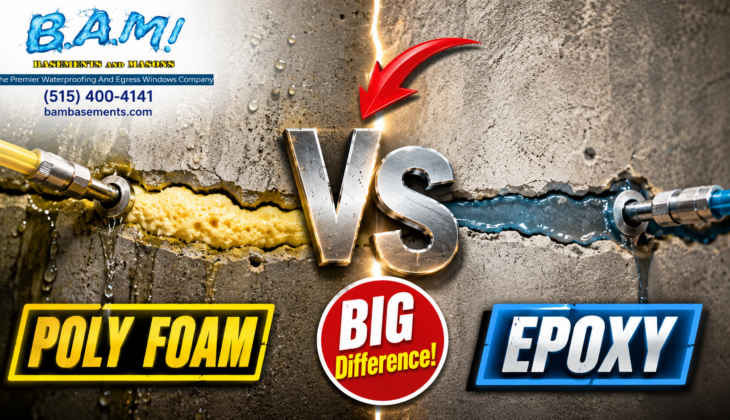
Choosing Between Polyurethane Foam and Epoxy for Cracks: What You Need to Know
- Horizontal foundation cracks often indicate structural problems, not just waterproofing issues — choosing the correct repair material depends on the specific damage the crack is causing to your wall.
- Epoxy injection is typically the preferred choice for horizontal cracks in dry or slightly damp conditions because it restores structural strength.
- Polyurethane foam is the preferred choice for active leaks, but it doesn’t add structural strength — a key point many DIY enthusiasts overlook.
- Some horizontal cracks need more than just an injection — if your walls are bowing or your cracks are widening, you may need a structural engineer before you inject any material into the crack.
- Bam Basements is a specialist in assessing and repairing foundation cracks — continue reading to find out how choosing the wrong material can worsen a crack over time.
Choosing the wrong material for a horizontal foundation crack isn’t just a waste of money — it can also exacerbate a serious structural issue.
Most homeowners only start to think about this when they have water coming in and they need a quick solution. It’s a natural instinct, but horizontal cracks are different from vertical or diagonal cracks, and the way you fix them should reflect that. Bam Basements deals with foundation cracks all the time and we’re always asked the same question: should I use polyurethane or epoxy? The answer depends on what the crack is actually doing, not just what it looks like.
Horizontal Cracks: More Than Just a Waterproofing Issue
Discovering a horizontal crack running across your basement wall is not the same as finding a hairline shrinkage crack near a window corner. This type of crack is one of the most alarming a homeowner can find, and to treat it as a simple moisture problem is to miss the point.
Horizontal cracks are usually caused by lateral pressure, which is when the soil and water outside your foundation wall pushes inward. This pressure can cause the wall to flex, bow, or even fail over time. Sealing the crack with foam might stop the leak, but it doesn’t do anything to fix the force that caused the crack to begin with.
The Reason Horizontal Cracks are More Severe Than Vertical or Diagonal Ones
Vertical cracks are a frequent occurrence in poured concrete foundations, often due to normal curing shrinkage or minor settlement. Diagonal cracks often indicate differential settlement, where one part of the foundation is sinking slightly faster than another. Both can be severe, but horizontal cracks are a different matter altogether. They indicate that the wall is under bending stress, which poses a direct threat to the structural integrity. A wall under bending stress can deflect inward, and once this process begins, it tends to continue without intervention.
How Soil Pressure Contributes to Horizontal Foundation Cracks
The soil around your foundation is always on the move. It swells when it’s wet, shrinks when it’s dry, and freezes in cold weather — each of these cycles puts more stress on the wall. Hydrostatic pressure from groundwater also pushes against the wall below grade, adding even more force.
Soils that are heavy in clay are especially troublesome. They hold moisture and swell greatly, producing enough side force to break block or poured concrete walls in just one freeze-thaw cycle. If your house is located in an area with a lot of clay soil or poor drainage, a horizontal crack is not a coincidence — it’s an expected outcome of constant pressure.
Recognizing that pressure is the main culprit is important because it affects how you assess every repair method. Injecting material into the crack treats the symptom. Dealing with the pressure source — by improving drainage, reinforcing the wall, or both — treats the cause.
When Injection Alone Won’t Do the Trick
If the wall is clearly bending inward, if the crack has grown wider over time, or if there are several horizontal cracks at various heights, injection alone won’t be enough to fix the problem. These are indicators that the wall has moved or is still moving. In these scenarios, a structural evaluation should be performed before any injection product is used.
The Function of Epoxy Injection in a Foundation Crack
For many years, epoxy injection has been a common method for repairing structural concrete. The process involves filling the entire depth of a crack with a two-part adhesive that hardens into a bond that is stronger than the surrounding concrete. In fact, it usually surpasses 6,000 psi in tensile strength.
This method requires drilling or surface-mounting injection ports along the crack, and then carefully pumping in low-viscosity epoxy until it fills the entire crack from one port to the next. Once it hardens, the crack is essentially sealed shut from the inside.
The Actual Effect of Epoxy on a Crack
Epoxy doesn’t just occupy space — it forms a chemical bond with the concrete on both sides of the crack, creating a solid, load-bearing connection. This is what makes it suitable for horizontal cracks where structural integrity is the issue.
- Bonds to concrete with tensile strength exceeding the concrete itself
- Fills hairline to moderately wide cracks (typically 0.002 inches to 0.5 inches)
- Creates a rigid, non-flexible repair that resists future movement at that point
- Restores the wall’s ability to act as a single structural unit
- Does not expand, shrink, or compress after curing
Because it cures rigid, epoxy essentially glues the two faces of the crack back together. In a horizontal crack that has stabilized — meaning the wall is not actively moving — this is exactly what you want.
One key thing to note is that epoxy needs a fairly dry crack to bond effectively. If water is constantly leaking through, the epoxy won’t stick properly and the repair won’t last as long as it should.
The Benefits of Rigidity for Horizontal Cracks
While some might believe that a flexible repair material is always the best choice, this is not the case when it comes to structural horizontal cracks. If a flexible material is used in a crack that is under lateral pressure, it will compress and deform as the wall continues to shift. The rigidity of epoxy means it can resist this movement and aid in keeping the wall intact — as long as the underlying pressure problem is not so severe that the wall is still actively moving.
What Epoxy Needs to Work Well
Epoxy injections are most effective when the crack is dry or slightly damp, the wall is no longer actively shifting, and the temperature during application is above 40°F. Moisture contamination is the most common cause of epoxy repair failure, which is why it’s important to address active leaks—sometimes with a temporary polyurethane foam injection—before applying epoxy.
The Process of Polyurethane Foam Injection
When using polyurethane foam injection, the approach is entirely different. The foam doesn’t bond to the concrete, instead, it expands to fill the crack and creates a flexible barrier that is resistant to water. The foam has a reaction with moisture, which includes the water that is seeping through the crack. This means that wet conditions actually help it cure instead of preventing it from working.
When you need to quickly stop water from seeping through a crack, polyurethane foam is the obvious choice. The foam expands to many times its original volume, filling gaps and irregular crack shapes that a low-viscosity liquid like epoxy might not be able to reach. After it has hardened, it stays flexible and can handle minor shifts in the concrete without breaking the seal.
The Expansion of Polyurethane and Its Effects on Your Foundation
Upon making contact with the moisture inside a crack, polyurethane foam undergoes a chemical reaction that causes it to expand rapidly. Depending on the specific product used, the foam can expand to a size 10 to 40 times larger than its original volume. This expansion is what allows the foam to fill irregular voids, pass through interconnected networks of cracks, and seal off areas that are hard to reach with rigid materials.
However, this expanding attribute can also be a disadvantage. The foam fills the crack by volume rather than by bonding strength, meaning it does not reconnect the two sides of the crack structurally. The wall will remain in the same position it was in when the foam was injected. If lateral pressure continues to push the wall inward, the foam will compress or the crack will reappear at a different point. This is a major issue for a horizontal crack under ongoing structural stress.
When Polyurethane Foam Beats Epoxy
There are certain circumstances where polyurethane foam is the clear choice, and epoxy would probably result in a botched repair.
- Active water infiltration: Foam reacts with moisture and cures in wet conditions where epoxy cannot bond properly
- Cracks with movement: Flexible foam accommodates minor ongoing concrete movement without cracking or separating
- Wide or irregular cracks: The expansion fills irregular voids more completely than low-viscosity epoxy in some geometries
- Non-structural vertical or diagonal cracks: When waterproofing is the only goal, foam delivers a durable, flexible seal
- Emergency water stops: Fast-reacting polyurethane foam can stop active flooding in a crack almost immediately
The takeaway is that polyurethane foam is a waterproofing tool, not a structural repair tool. That distinction matters enormously when you are dealing with a horizontal crack where both water intrusion and structural integrity may be at stake.
There are some professional repair situations where both materials are used in a specific order. A polyurethane foam injection is used first to stop active water and dry out the crack, followed by an epoxy injection when conditions are right for bonding. This step-by-step method gets the most out of each material.
Yet, this dual-action method requires precise timing, knowing what products work well together, and having the correct injection tools. It is not something that a DIY kit you bought from the store can handle effectively, and if you do it wrong, you could trap moisture inside the wall or create a bond that fails when the first freeze-thaw cycle happens.
Comparing Epoxy and Polyurethane: A Detailed Look
While both substances are injected into cracks via ports, that’s about where the similarities stop. The table below outlines the main differences to help you quickly determine which one is right for your particular case.
| Characteristic | Epoxy Injection | Polyurethane Foam Injection |
|---|---|---|
| Main use | Structural restoration | Sealing leaks / waterproofing |
| Strength of bond | Higher than concrete (tensile strength over 6,000 psi) | Low — foam does not structurally bond |
| Tolerance to moisture | Requires crack to be dry or nearly dry | Cures in response to moisture |
| Flexibility after curing | Rigid — does not tolerate movement | Flexible — can accommodate minor movement |
| Expansion during curing | None | 10x to 40x the volume injected |
| Best type of crack | Dry horizontal or structural cracks | Active leaks, vertical, non-structural |
| Sensitivity to temperature | Requires temperature above 40°F | Can tolerate cooler conditions |
| Typical lifespan | Decades if applied correctly | Years, may need to be reapplied |
Structural Strength
When it comes to structural strength, epoxy is the clear winner. A properly injected epoxy repair creates a bond that is actually stronger than the surrounding concrete, effectively making the cracked section monolithic again. Polyurethane foam has no meaningful structural strength — it fills and seals, but it does not hold the wall together under load.
Dealing with Water and Moisture
When it comes to dealing with water actively seeping through a crack, polyurethane foam is the only practical solution. Epoxy needs a dry surface to form a chemical bond with the concrete. Even a little bit of seepage can weaken the epoxy’s adhesion and cause a repair that appears to be successful but fails within a season. If your horizontal crack is wet, polyurethane is the first choice — or a drainage solution is put in place before attempting to use epoxy.
Adaptability and Resistance to Movement
Although polyurethane foam remains pliable after it sets, this isn’t necessarily a good thing. When dealing with a horizontal crack under lateral soil pressure, resistance — not flexibility — is key. The rigidity of epoxy is a plus, not a minus, because it helps keep the cracked concrete together and fights against the forces trying to separate it. However, if a crack is in a location that’s subject to typical thermal expansion and contraction rather than structural stress, flexibility is more beneficial.
Which Method is Best for Each Crack Type
In a nutshell: use epoxy for dry horizontal cracks where the priority is structural integrity, and use polyurethane foam for active leaks, vertical shrinkage cracks, and situations where the crack is non-structural and water is the main concern. If you’re unsure whether a horizontal crack is structural, get a professional assessment before choosing either material — making the wrong decision can hide a problem that continues to worsen behind the repair.
A Quick Guide to Choosing the Right Material
Here’s an easy way to remember it — use epoxy for strength, and polyurethane for sealing. If your horizontal crack is dry and you need to reinforce the wall’s structural integrity, epoxy injection is your best bet. If water is actively seeping through and you need to waterproof immediately, polyurethane foam is the way to go, especially in conditions where epoxy wouldn’t work.
Horizontal cracks are especially problematic because they often require both a professional evaluation to ensure the wall is stable and the right injection material based on the moisture conditions at the time of repair. The biggest and most expensive mistake homeowners often make with this type of crack is to skip the evaluation step and go straight to a store-bought kit.
How to Tell if a Structural Engineer Should Examine Your Horizontal Crack First
While not every horizontal crack necessitates the involvement of an engineer, there are certain red flags that suggest that injection shouldn’t be the initial course of action. If any of these signs are present, a structural evaluation should be conducted before any repair material is used.
Walls That Bow or Bulge
When the wall along the crack is visibly pushed inward, even if it’s just a little bit, it means that the wall has already moved due to lateral pressure. If you inject epoxy or foam into a wall that is actively moving, it won’t stop the movement. The repair material might crack, debond, or just move along with the wall. This leaves you with a repair that didn’t work and a wall that has moved even more than before you tried to fix it.
Deflection from plumb is the measurement of bowing, and even a quarter-inch inward bow on a block or poured concrete wall should be taken seriously. If there’s an inch or more of deflection, most structural engineers will recommend reinforcement, such as carbon fiber straps or wall anchors, before or in conjunction with any crack injection work.
Cracks That Get Bigger Over Time
If you notice that a crack that was once barely noticeable six months ago is now clearly wider, this is a strong indication that the force causing the crack is still at work. The fact that the crack is actively getting wider is one of the most obvious signs that the wall is still shifting, which means the structural issue is current and not something that happened in the past.
Keeping an eye on crack width is easy. Simply mark the ends of the crack with a pencil line and date it, or put a small amount of plaster across the crack as a tell-tale. If the plaster cracks or the marked ends extend within a few weeks, the crack is active. Measure the width at multiple points along the crack using a crack gauge or even a simple ruler, and monitor it over several weeks before deciding on any repairs. For horizontal cracks, epoxy injection is usually the better choice.
If a horizontal crack is getting wider and the wall is moving inward, you need to call a structural engineer right away. Don’t try to fix it yourself by injecting material into the crack. This will only cover up the problem for a short time. The damage will continue to get worse.
- Mark crack ends with pencil lines and dates to track extension over time
- Use a crack comparator gauge to measure width at multiple points along the crack
- Apply a plaster tell-tale across the crack to detect even minor fresh movement
- Photograph the crack monthly with a ruler in frame for clear visual documentation
- Note whether widening is seasonal — some cracks widen in winter due to frost and narrow in summer
Stair-Step Cracking Alongside Horizontal Damage
When stair-step cracks — those diagonal cracks that follow the mortar joints in a block wall — appear alongside horizontal damage, the foundation is showing multiple types of stress at the same time. Stair-step cracking on its own typically indicates differential settlement, but when it appears alongside horizontal cracking, it suggests the wall is experiencing both lateral pressure and uneven settlement simultaneously. That combination is more complex than either crack type alone and almost always warrants professional evaluation.
Keep a sharp eye on where the stair-step cracks start in relation to the horizontal crack. If the stair-step cracks are spreading out from the ends of a horizontal crack, the horizontal crack might be continuing to spread along the wall under ongoing stress. This pattern suggests that the wall isn’t just bowing — it might be starting to fail in a more widespread manner.
How Bam Basements Deals With Horizontal Foundation Cracks
At Bam Basements, each horizontal crack evaluation begins with determining the wall’s stability before any injection material is suggested. The procedure includes checking for inward deflection, measuring the width of the crack at various points, discussing the crack’s history with the homeowner, and assessing the drainage conditions outside the wall. From there, the repair strategy is tailored to the actual condition — epoxy injection for dry, stable cracks where structural integrity is the goal, polyurethane foam for active water infiltration, and referrals for structural reinforcement when the wall has shifted beyond what injection alone can handle. The right repair is never a one-size-fits-all solution, and horizontal cracks deserve that level of detail.
Common Questions
When homeowners are trying to decide between polyurethane foam and epoxy for a horizontal foundation crack, these are the questions they ask most frequently. The answers below provide useful, practical information for this specific type of crack.
Is it Possible to Inject a Horizontal Crack Myself Using a Kit Purchased From a Store?
Technically, yes — both epoxy and polyurethane foam injection kits are available for DIY use. However, whether you should attempt this depends entirely on the type of crack you are dealing with and your ability to accurately assess the conditions.
- Width of the crack: Most DIY epoxy kits work reliably only on cracks between 0.002 and 0.3 inches — hairline to roughly the width of a credit card edge
- Level of moisture: If there is any active seepage, DIY epoxy will not bond and the repair will fail
- Movement of the wall: A wall that has visibly bowed or a crack that is widening is not a DIY injection situation under any circumstances
- Spacing of the ports: Professional injection uses ports spaced based on crack geometry and depth — DIY kits use fixed spacing that often results in incomplete fill
- Control of the pressure: Professional equipment maintains consistent low pressure to drive material through the full crack depth without causing surface bridging
A DIY kit on a small, dry, stable vertical crack is a reasonable repair. A DIY kit on a horizontal crack in a basement wall that has shown any signs of structural stress is a different situation entirely. The risk is not just a failed repair — it is sealing the surface of a crack while the underlying damage continues, making future professional assessment harder.
For smaller, non-structural cracks that are dry and have not changed in size over a period of time, a good DIY epoxy injection kit could be the answer. The Polygem Concrete Crack Injection Kit and the Simpson Strong-Tie crack repair system are two of the better DIY options for these types of cracks.
When it comes to horizontal cracks, it is always a good idea to seek professional advice first. Many foundation experts provide free or low-cost evaluations, and it is always worth the effort to determine if your crack is structural before spending money on materials.
How Can I Tell if My Horizontal Crack Is Structural or Simply a Leak?
A horizontal crack that is simply a leak — meaning water is seeping through a wall that is otherwise stable — will be consistent in width from one end to the other, will not show signs of displacement on either side, and will not be accompanied by any inward bowing of the wall. The crack appeared at some point, has not changed since, and the wall behind it is still plumb and straight. These cracks are relatively uncommon because horizontal cracks are more often caused by lateral pressure, but they do exist, particularly in older poured concrete walls that have minor cold joints or pour lines.
On the other hand, a structural horizontal crack often presents with a slight displacement between the two sides of the crack, with one side appearing slightly pushed inwards compared to the other. The wall may not be perfectly vertical when measured with a level. The crack may be wider in the middle than at the ends, suggesting that the wall is bowing at that point. Any of these signs, particularly inward displacement or wall bowing, indicate that the crack has moved from being a waterproofing issue to a structural issue, and the next appropriate step would be an engineer’s assessment.
Can Epoxy Injection Prevent Water from Seeping Through a Horizontal Crack?
Once fully cured, epoxy injection can seal a crack and stop water from seeping through — but only if the crack was sufficiently dry during application for the epoxy to properly adhere to both sides of the concrete. A well-done epoxy injection on a dry horizontal crack will prevent water from seeping through from that point onwards.
Unfortunately, epoxy and active water don’t get along. If water is seeping through the crack at the time of injection, the epoxy won’t be able to form a proper chemical bond with the concrete surface. The repair may seem complete, but the first significant rain event or rise in groundwater will find its way through the unbonded area. In wet conditions, polyurethane foam is first injected to stop the water, the wall is allowed to dry thoroughly, and then epoxy can be applied as a structural follow-up if necessary.
What is the Lifespan of Epoxy or Polyurethane Injection in a Foundation Crack?
When epoxy injection is applied correctly on a stable crack, it can last for many years. The cured epoxy bond is stronger than the concrete around it, so the repaired crack itself is unlikely to re-open. Instead, a new crack may form next to the repair over a long period of time due to ongoing stress. Many professionally injected epoxy repairs stay intact for the rest of the structure’s life, as long as the underlying pressure issues have been taken care of.
Repairs made with polyurethane foam usually last for a few years to about a decade, depending on how much the crack moves, how often it gets wet and dries out, and which product is used. The foam can flex a bit, but if the crack moves a lot, such as from freezing and thawing, pressure from the side, or the crack getting wider, the foam can get squished or moved to the side enough that water can get in again. You’re more likely to need to fix the crack again if you use polyurethane foam than if you use epoxy.
Regardless of whether you choose polyurethane foam or epoxy, the lifespan of the repair will depend on whether the underlying cause of the crack — such as hydrostatic pressure, poor drainage, or soil movement — has been addressed. If the same stress conditions persist after the crack has been injected, it will need to be treated again, regardless of the material used.
Can I Continue Living in My House if There’s a Horizontal Crack in the Foundation?
Generally, yes — if there’s only one horizontal crack, it’s not getting bigger, and there’s no noticeable bowing in the wall, then it’s not an immediate safety risk. Foundations are built to handle a lot of weight, so a single crack doesn’t mean the wall is about to collapse. However, you shouldn’t take a horizontal crack lightly or just keep an eye on it. It needs to be checked out and monitored properly.
When the wall is noticeably bowing inward, the crack has widened noticeably in a short period, there are multiple horizontal cracks at different heights on the same wall, or there are stair-step or diagonal cracks, these are the situations that need more urgent attention. These symptoms indicate more significant structural stress that requires a professional structural assessment as soon as possible.
You didn’t provide any content to be rewritten. Please provide the content you want me to rewrite.