
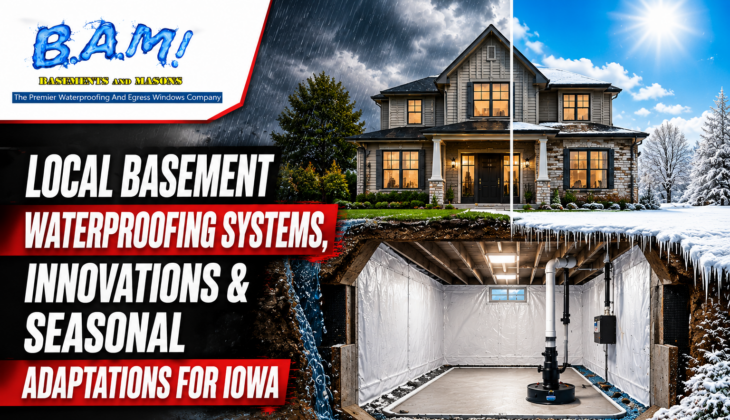
Iowa Basement Waterproofing At A Glance
- Iowa’s clay-heavy soil and seasonal snowmelt create some of the most aggressive basement water conditions in the Midwest — and a single-product fix rarely holds up long-term.
- The right waterproofing system depends entirely on your water source — surface runoff, rising groundwater, and hydrostatic pressure each demand a different solution.
- Spring is the highest-risk season for Iowa basements, but winter moisture buildup quietly sets the stage for mold, odors, and structural damage if left unmanaged.
- Full-system waterproofing — combining interior drainage, sump pumps, sealing, and dehumidification — is now the standard approach among experienced Iowa contractors, and for good reason.
- Structural wall issues must be resolved before any waterproofing system is installed — skipping this step is one of the most common and costly mistakes Iowa homeowners make.
Iowa basements face a specific set of conditions that make waterproofing not just a comfort upgrade, but a structural necessity. Bam Basements works with Iowa homeowners to identify exactly what is driving moisture into their foundation before recommending any system — because the wrong fix is often worse than no fix at all.
Iowa Basements Leak For Specific Reasons — Here Is What You Need To Know First
Most basement leaks are not random. In Iowa, the combination of expansive soil, a seasonally high water table, and dramatic temperature swings creates predictable, repeating pressure on foundation walls and floors. Understanding what is actually happening beneath your home is the only way to stop it for good.
Why Iowa Soil and Groundwater Make Basements Vulnerable
Iowa’s soil is heavily clay-based across much of the state, particularly in central regions around Des Moines. Clay soil absorbs water readily but drains slowly, which means it stays saturated for extended periods after heavy rain or snowmelt. That saturated soil presses directly against your foundation walls with enormous force.
When clay soil cycles through wet and dry phases, it also expands and contracts. Over time, this movement works against concrete and block foundation walls, opening hairline cracks and widening existing ones. Those gaps become the entry points for groundwater, especially when the water table rises close to basement level — something that happens regularly in low-lying Iowa neighborhoods.
The Difference Between Surface Water, Groundwater, and Hydrostatic Pressure
Not all basement water comes from the same place, and misidentifying the source leads to failed repairs. Surface water enters during or immediately after rain events — often through window wells, door gaps, or cracks near the top of the foundation wall. Groundwater rises from below, seeping through the floor or the lower portions of walls when the water table is elevated. Hydrostatic pressure is the force that saturated soil exerts against the foundation — it does not require a visible crack to push moisture through porous concrete over time.
How Spring Snowmelt Pushes Water Toward Your Foundation
Spring is Iowa’s most dangerous season for basements. When accumulated snow melts rapidly — often combined with early spring rainfall — the ground becomes oversaturated faster than it can drain. Water follows the path of least resistance, and that path frequently leads directly to the foundation perimeter. In cities like Des Moines, Cedar Rapids, and Davenport, the water table can rise to within a few feet of the basement floor during peak spring thaw, putting enormous hydrostatic pressure on even well-built foundations.
The Core Waterproofing Systems Iowa Homes Actually Need
Iowa homes generally require layered waterproofing rather than a single solution. The systems below are the primary tools used by experienced contractors, and most complete waterproofing projects combine at least two or three of them working together.
Interior Drain Tile and French Drain Systems
Interior drain tile systems are one of the most reliable long-term solutions for Iowa basements that experience water intrusion through the floor or lower walls. A channel is cut along the interior perimeter of the basement floor, and a perforated pipe is installed to collect incoming water before it can pool on the floor. That water is then routed to a sump pit and removed by a pump.
The reason interior drain tile works so well in Iowa is that it does not try to stop water at the wall — it manages water after it enters. This approach is more durable under Iowa’s freeze-thaw conditions than exterior-only systems, which can shift or become blocked when soil repeatedly expands and contracts through the winter months.
Sump Pumps: What Capacity Iowa Homes Require
A sump pump is the mechanical heart of most Iowa basement waterproofing systems. For homes in moderate-risk areas, a pump rated at 1/3 horsepower with a capacity of around 2,000 to 2,500 gallons per hour is typically sufficient. High-risk homes — particularly those in low-lying areas or near waterways — often require 1/2 horsepower pumps or even dual-pump configurations with a battery backup system to handle power outages during storms. Battery backup units are not optional in Iowa; they are a practical necessity given how often severe spring storms knock out power at exactly the moment the pump is needed most.
Exterior Membranes and Drain Systems
Exterior waterproofing involves excavating the soil around the foundation and applying a waterproof membrane directly to the outside of the foundation wall. This is the most comprehensive approach because it stops water before it ever contacts the structure. However, it is also the most disruptive and expensive method, requiring full excavation down to the footing.
In Iowa, exterior systems are most justified when a foundation wall has significant structural damage or when interior methods have already been tried and have not resolved the problem. For new construction, exterior membranes combined with drainage board and a footing drain are considered best practice. For existing homes, the cost-to-benefit ratio often favors interior systems unless exterior issues are severe.
When exterior drainage is installed, a dimple mat or drainage board is typically placed over the membrane to create an air gap that directs water down to the footing drain rather than letting it press flat against the wall coating. This detail matters significantly in Iowa, where hydrostatic pressure is a recurring seasonal force rather than an occasional event.
System Type Best Used For Iowa Suitability Relative Cost Interior Drain Tile Floor/lower wall seepage Excellent — freeze-thaw resistant Moderate Sump Pump System Water table management Essential for most Iowa homes Low to Moderate Exterior Membrane Structural wall protection Best for new builds or severe cases High Vapor Barrier/Encapsulation Humidity and condensation control Strong for crawl spaces and damp basements Low to Moderate French Drain (Exterior) Surface and groundwater diversion Effective combined with other systems Moderate
Choosing the right exterior system requires an honest assessment of your foundation’s current condition, your lot’s drainage characteristics, and your budget. A qualified Iowa waterproofing contractor should evaluate all three before recommending excavation.
Vapor Barriers and Full Encapsulation
Vapor barriers are heavy-duty polyethylene sheets applied to basement walls and floors — or across crawl space surfaces — to block moisture vapor from passing through porous concrete and soil. Full encapsulation goes further by sealing the entire crawl space or basement envelope, including walls, floor, and any exposed structural elements. In Iowa’s humid summers and cold winters, encapsulation paired with a high-performance dehumidifier significantly reduces the condensation, odors, and mold risk that chronic dampness creates.
Wall Cracks vs. Seepage: How To Tell The Difference
Knowing whether you are dealing with a crack problem or a seepage problem changes everything about how the repair should be approached. Wall cracks are visible fractures in the foundation wall — they may be hairline-thin or wide enough to insert a finger into, and they often appear in stair-step patterns on block foundations or as vertical and horizontal lines on poured concrete walls. Seepage, on the other hand, may show no visible crack at all. Water moves through the porous concrete itself, leaving white mineral deposits called efflorescence, damp patches, or a general musty smell without any obvious entry point.
Horizontal cracks are the most serious category and should never be ignored. They typically indicate that lateral soil pressure — exactly the kind Iowa’s clay-heavy soil generates — is actively bowing the wall inward. A wall showing horizontal cracking needs structural evaluation before any waterproofing product is applied, because sealing over a structurally failing wall will not stop the movement and can mask the problem until it becomes catastrophic.
Wall Anchors, Push Piers, and Foundation Stabilization
When a foundation wall has moved or is under active lateral pressure, waterproofing alone is not enough. Wall anchors are steel plates installed on the interior of the wall and connected by a rod to a anchor plate buried in stable soil away from the foundation. Over time, the anchor system can be tightened to gradually straighten a bowing wall. Carbon fiber straps are used for walls that have bowed but not yet significantly displaced — they bond directly to the wall surface and resist further inward movement without requiring excavation. For settling foundations, push piers or helical piers are driven deep into load-bearing soil beneath the footing to stabilize and sometimes lift a sinking foundation back toward its original position. Each of these solutions must be completed and verified stable before any waterproofing membrane, drain tile, or sealant is applied.
The Shift To Full-System Waterproofing Solutions In Iowa
Iowa contractors have moved decisively away from single-product fixes over the past decade. The reason is straightforward — a crack filler does nothing for rising groundwater, and a sump pump alone cannot address vapor transmission through walls. The homes that stay dry year after year are the ones where multiple systems work together as an integrated solution.
Why Single-Product Fixes Often Fall Short
Hydraulic cement and masonry crack fillers are widely sold at hardware stores and frequently applied as a first response to a wet basement. They can temporarily stop an active leak at a specific crack, but they do nothing to address the water pressure building behind the wall, nor do they manage humidity or groundwater. When Iowa’s spring thaw arrives, that pressure simply finds a new path. Homeowners who go through multiple rounds of patching before finally investing in a complete system almost universally report that the patchwork approach cost them more in the long run than a full solution would have from the start.
How Drainage, Pumping, Sealing, and Dehumidification Work Together
A complete waterproofing system works in layers. Interior drain tile collects water that enters through the floor or lower walls and channels it to the sump pit. The sump pump then expels that water away from the foundation before it can accumulate. Wall sealants and membranes reduce the volume of water entering in the first place, relieving pressure on the drainage system. Finally, a dehumidifier manages residual moisture vapor that passes through even well-sealed surfaces.
Each layer handles what the others cannot. Drainage without dehumidification still leaves a basement damp and prone to mold. Sealing without drainage creates a false sense of security that fails the moment pressure exceeds what the sealant can hold. Dehumidification without structural waterproofing just fights a losing battle against ongoing water intrusion. The system only performs at full capacity when all four elements are present and properly sized for the home.
This integrated approach is particularly important in Iowa because the stress on basement systems is not constant — it peaks sharply in spring and during heavy summer thunderstorms, then drops off in drier months. A system designed only for average conditions will be overwhelmed during peak stress periods, which is precisely when it matters most.
High-Performance Dehumidifiers and Clog-Resistant Drainage Components
Basement-rated dehumidifiers are a meaningful step up from portable household units. Units designed specifically for below-grade environments operate effectively at lower temperatures, handle higher moisture loads, and are built to run continuously without burning out — a critical feature in Iowa where summer humidity regularly pushes basement relative humidity above 70%. On the drainage side, clog-resistant drain tile systems use filter fabric or specially designed perforations that resist the fine clay particles common in Iowa soil, preventing the gradual blockage that renders older French drain systems ineffective over time.
Seasonal Waterproofing Adaptations Every Iowa Homeowner Should Make
Iowa’s climate does not give basements a break. Each season brings a different type of moisture stress, and a waterproofing plan that only accounts for one season will underperform during the others. Adapting your maintenance approach to match the seasonal risk cycle is what separates a dry basement from a repeatedly flooded one.
Spring: The Highest-Risk Season for Iowa Basements
Spring consistently delivers the most intense waterproofing stress Iowa basements face. Snowmelt, saturated soil, and early-season rainstorms combine to push groundwater levels higher and faster than any other time of year. In areas like Des Moines and Cedar Rapids, the water table can approach basement floor level during a heavy spring thaw, putting every element of a waterproofing system under simultaneous pressure. A pump that performed adequately all winter may be completely overwhelmed by mid-March if it has not been serviced and if a battery backup is not in place.
Pre-Spring Checklist: Gutters, Grading, Pumps, and Backup Systems
Task Why It Matters for Iowa Basements Timing Clean and inspect gutters Blocked gutters dump water directly at the foundation perimeter Late February or early March Extend downspouts Discharge should exit at least 6 feet from the foundation Before first thaw Check soil grading Ground should slope away from the house at a minimum 6-inch drop over 10 feet After ground thaws Test sump pump operation Pour water into the pit to confirm float trigger and discharge function Late February Inspect battery backup unit Spring storms frequently knock out power during peak pump demand Late February Clear window well drains Debris-blocked wells fill with snowmelt and push water through basement windows Early March
Completing this checklist before the first significant thaw gives every component of your waterproofing system the best chance of performing under peak spring load. Most pump failures and drainage overflows that Iowa homeowners experience in March and April trace directly back to deferred maintenance from the previous fall.
Downspout extension is one of the most underestimated items on this list. A downspout that discharges at the foundation wall deposits hundreds of gallons of water directly into the soil zone that presses against your basement — essentially negating the work of your interior drainage system. Extensions are inexpensive, easy to install, and have an immediate impact on water volume at the foundation perimeter.
If your sump pump is more than seven years old, pre-spring is the right time to evaluate replacement rather than waiting for it to fail during a storm. Iowa’s spring season does not offer a grace period — a pump that fails on a heavy rain night in April can result in several inches of standing water within hours.
Winter Moisture Control To Prevent Condensation and Mold
- Maintain basement temperature above 55°F to reduce the temperature differential that causes condensation on cold concrete walls and floors.
- Run a basement-rated dehumidifier year-round — not just in summer — because cold air that enters a basement and warms up carries moisture that then deposits on surfaces.
- Inspect vapor barriers and encapsulation seams in late fall before ground freeze, repairing any tears or separations that would allow moisture vapor to bypass the barrier.
- Check crawl space vents — in Iowa winters, open crawl space vents allow cold, moist outside air to contact warm interior surfaces, generating condensation and accelerating wood rot.
- Monitor for efflorescence on foundation walls through winter, as new white mineral deposits indicate active water movement through the concrete even when no liquid pooling is visible.
Winter moisture damage in Iowa basements is cumulative and slow-moving, which is exactly why it gets ignored until the problem is significant. Mold colonies that establish during winter months on framing, insulation, or drywall do not disappear when spring arrives — they expand. A basement that smells musty every March is not experiencing a spring problem; it is revealing a winter moisture problem that has been building for months.
Condensation is particularly deceptive because homeowners often mistake it for a leak. If water appears on your basement walls primarily during cold weather without a corresponding rain event, and if it seems to come from the surface rather than through a specific crack, condensation is the more likely culprit. The fix in this case is temperature and humidity management rather than drainage — another reason why accurate diagnosis drives the right solution.
How To Choose The Right Waterproofing System For Your Iowa Home
The single most important step Iowa homeowners can take is resisting the urge to purchase a product before identifying the problem. The waterproofing market is full of coatings, sealers, and drainage kits marketed as universal solutions, but no product works correctly when applied to the wrong problem. A professional inspection that documents the water source, entry points, soil conditions, and current structural integrity of the foundation is the only reliable starting point for a system that will actually perform through Iowa’s seasonal extremes.
Start With A Professional Inspection, Not A Product
A qualified waterproofing contractor will assess your foundation walls for cracking patterns, check for efflorescence and staining that reveals where water is entering, evaluate your lot’s drainage characteristics, and test your existing sump system if one is present. That information drives the system recommendation — not a product catalog. Any contractor who arrives and immediately quotes a single product without a thorough inspection of your specific conditions is not following a process that leads to lasting results. For more information on common methods, check out this article on Iowa basement waterproofing.
Matching The Solution To The Water Source
Surface water problems — where leaking correlates directly with rainfall events and water appears near the top of the foundation wall or through window wells — are often resolved with improved grading, extended downspouts, and window well covers before any interior system is needed. These are the lowest-cost interventions and should always be evaluated first. For more comprehensive solutions, Iowa basement waterproofing usually relies on a mix of interior drainage, sump pumps, and vapor barriers.
Groundwater intrusion, where water appears through the floor or lower wall sections and does not correlate neatly with surface rain, requires active drainage and pumping. Interior drain tile routed to a properly sized sump pump is the standard solution, and in high water table areas of Iowa, a battery backup pump is not optional — it is part of the core system design.
Hydrostatic pressure that has caused wall movement or cracking requires structural repair before waterproofing. Installing drainage behind a wall that is actively bowing inward only delays the structural failure while giving a false appearance of progress. The sequence matters: stabilize the structure, then waterproof, then manage humidity.
What A Realistic Iowa Waterproofing Project Costs
Iowa basement waterproofing projects typically range from around $2,500 for basic crack repair and sump pump installation to $15,000 or more for full perimeter drain tile systems combined with structural repair and encapsulation. Mid-range projects — interior drain tile with a primary and backup sump pump system — generally fall between $5,000 and $9,000 depending on basement size and existing conditions. Exterior excavation projects with membrane application sit at the higher end of the range given the labor and equipment involved.
These costs should be weighed against the alternative. A finished basement that floods repeatedly loses its value rapidly, and the cost of mold remediation, damaged possessions, and structural repair typically far exceeds what a properly designed waterproofing system would have cost. Iowa homeowners who treat basement waterproofing as an investment in the structural integrity of their home — rather than a repair cost — consistently make more cost-effective decisions about which systems to install and when.
Bam Basements Protects Iowa Homes With The Right System, Every Time
Iowa basements face conditions that demand more than a patch and a prayer. The right waterproofing system, installed in the right sequence, makes the difference between a basement that stays dry through every spring thaw and one that floods the same week every March without fail. Bam Basements brings that system-first approach to Iowa homeowners — starting with a thorough inspection and ending with a solution built specifically for your home’s conditions.
- Full-system design that integrates drainage, pumping, sealing, and humidity control rather than relying on a single product
- Structural assessment included in the inspection process so waterproofing is never applied over an unresolved foundation issue
- Seasonal expertise built from working through Iowa’s freeze-thaw cycles, spring snowmelt events, and humid summer conditions
- Properly sized sump pump systems including primary and battery backup configurations for high-risk Iowa properties
- Encapsulation and dehumidification solutions for basements and crawl spaces dealing with persistent vapor and humidity issues
Every Iowa home is different, and the water problem in a Des Moines split-level on clay soil is not the same as the one in a Cedar Rapids block-wall basement near a floodplain. That difference matters, and it is why a one-size-fits-all product recommendation is never the right answer.
Bam Basements approaches each project the way a dry basement actually requires — methodically, starting from the source of the water and building outward to a complete solution that holds up through Iowa’s most demanding seasons.
Frequently Asked Questions
What Is The Most Common Cause Of Basement Leaks In Iowa?
The most common cause of basement leaks in Iowa is hydrostatic pressure from clay-heavy, water-retaining soil pressing against the foundation during and after heavy rain or snowmelt events. Iowa’s soil stays saturated for extended periods, and that sustained pressure forces water through porous concrete, mortar joints, and existing cracks. Surface drainage failures — clogged gutters, short downspouts, and negative grading — frequently amplify the problem by adding surface water volume to an already saturated soil zone around the foundation perimeter.
Do Iowa Homeowners Need Both Interior And Exterior Waterproofing?
Most Iowa homeowners do not need both systems simultaneously. Interior drain tile with a sump pump handles the majority of water intrusion scenarios effectively and at significantly lower cost than exterior excavation. Exterior waterproofing is most justified for new construction, for homes with severely damaged foundation walls, or for situations where interior methods have been correctly installed and have not resolved the problem. A professional inspection determines which approach — or which combination — applies to your specific home and site conditions.
How Often Should A Sump Pump Be Replaced In An Iowa Home?
A residential sump pump in an Iowa home should typically be replaced every 7 to 10 years, though pumps in high water table areas or those that run frequently during spring and summer may show wear closer to the 5 to 7 year mark. Annual testing — pouring water into the pit to confirm the float trigger activates correctly and water discharges fully — catches early signs of motor wear or switch failure before a storm creates the real test. Battery backup units should have their batteries inspected and replaced on the manufacturer’s recommended schedule, typically every 3 to 5 years.
Can Basement Waterproofing Prevent Mold Growth?
Yes — effective basement waterproofing significantly reduces mold risk by eliminating the persistent moisture that mold requires to establish and spread. However, waterproofing alone is not always sufficient if vapor transmission through walls continues to elevate relative humidity above 60%. A complete system that includes encapsulation and a basement-rated dehumidifier maintains relative humidity at levels — generally below 50% — where mold growth is inhibited. Homes that waterproof without addressing residual humidity often find that mold risk drops but does not disappear entirely until the full moisture envelope is managed.
What Is The Best Time Of Year To Waterproof A Basement In Iowa?
Late summer through early fall is generally the best window for basement waterproofing installation in Iowa. Ground conditions are typically drier after summer’s end, making exterior excavation easier and less disruptive. Interior drain tile installation can proceed year-round since it does not depend on soil conditions, but scheduling before the fall rain season and well ahead of spring thaw gives the system time to be fully operational before peak stress periods arrive.
Winter installations are possible for interior systems but are not ideal for exterior work, as frozen ground significantly complicates excavation and membrane curing. Spring installations, while timely in terms of motivation, often mean scheduling during the busiest period for Iowa waterproofing contractors — which can extend lead times and delay the very protection the homeowner urgently needs.
The practical takeaway: if your basement has shown water problems this past spring, do not wait until the following March to address them. Late summer and fall scheduling puts a complete, tested system in place before Iowa’s next high-risk season arrives — and that timing difference is often the difference between a dry basement and another round of water damage. Bam Basements helps Iowa homeowners evaluate, design, and install the right waterproofing system for their home’s specific conditions, so the next spring thaw is not something to dread.