
Des Moines Basics: What You Need to Understand Before You Begin Construction
- Des Moines is located on glacial till, a dense and inconsistent combination of clay, silt, sand, and gravel that moves with seasonal moisture changes.
- In the Des Moines region, stable bearing soil can be located tens of feet beneath the surface, making shallow foundations a long-term hazard.
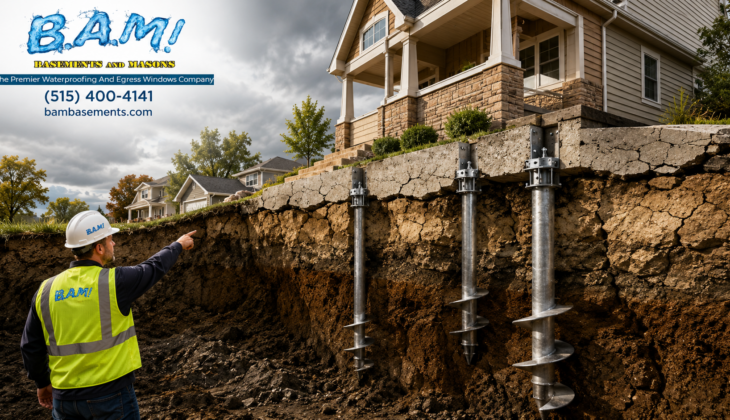
- Helical piers are designed to screw past weak, moisture-sensitive layers and anchor into competent soil deeper underground.
- Installation torque is monitored in real time during helical pier placement, providing contractors with an immediate and reliable measure of load capacity.
- Bam Basements works directly with Des Moines homeowners and builders who are dealing with these specific soil challenges — continue reading to understand why local conditions change everything about how foundations are designed.
If you’re building or repairing foundations in Des Moines, the ground itself is your enemy in ways that aren’t always apparent until something moves.
Des Moines has a legacy of glacial activity that has created one of the most diverse soil profiles in the Midwest. This means that the rules that apply to foundation work in other parts of the country don’t always apply here. Bam Basements has firsthand experience working with these conditions, and what follows is a technical breakdown of why helical piers are often the most reliable solution when the ground won’t cooperate.
Des Moines Homeowners Unaware of Local Soil Issue
When people think of foundation issues, they often think of visible signs such as drywall cracks, doors that refuse to close, or sloping floors. However, they often overlook what is happening 20 to 40 feet beneath the surface. This is where the real story is in Des Moines.
Most of the topsoil in the metro area is very responsive to moisture. In wet seasons, the clay-rich layers take in water and swell. In dry periods, they shrink. This ongoing cycle of swelling and shrinking puts pressure on foundations from underneath, and over time, it leads to movement that can’t be permanently fixed with any surface-level repair.
Understanding Glacial Till
Glacial till isn’t a consistent substance. It is the unsorted remnants left from the retreat of glaciers thousands of years ago. This can include anything from fine clay particles to large boulders, all deposited together without any layering or sorting by size. In Des Moines, this till can be quite deep and can change dramatically over short horizontal distances. This means that two footings on the same job site may come across completely different conditions just a few feet apart.
How Clay-Rich Soil Reacts to Moisture
Clay minerals are made up of platelets that can soak up water molecules in between their layers, leading to the substance expanding. When that moisture disappears — through evaporation or the activity of roots from nearby trees — those same platelets decrease in size and the soil contracts. In a glacial till environment with a lot of clay, like much of Des Moines, this process is ongoing and changes with the seasons.
What this means for foundations is that the soil they’re built on is never fully stable. The top few feet of even well-compacted fill or undisturbed native clay will react to rainfall, droughts, and changes in how water drains from the area. Any part of the foundation that relies on this soil to bear its weight is likely to move over time.
Finding Stable Ground: How Deep You Need to Go
For those in the Des Moines area, finding soil that can consistently bear loads often requires going far beneath the active moisture zone, which can extend 10 feet or more depending on the site’s conditions. You would need to reach the denser glacial till or deeper layers that don’t significantly respond to changes in surface moisture. There isn’t a one-size-fits-all depth answer because the profile varies throughout the metro. However, installations that only go a few feet into the soil generally don’t reach the material necessary for long-term stability.
Understanding the Function of Helical Piers
Helical piers are steel shafts that have one or more helical bearing plates welded onto them at specific intervals. Instead of being driven or drilled into the ground, these piers are installed by applying rotational torque, effectively screwing them into the soil. As the helical plates rotate through the soil, they pull the shaft downward with each revolution. This process continues until the pier reaches the desired depth or the necessary installation torque is achieved.
The Screw-In Method That Avoids Unstable Soil
The screwing action of a helical pier is what gives it its main advantage in variable soil conditions. Unlike driven piles that can deflect around obstructions or lose energy in soft layers, helical piers advance through the soil profile systematically. Extensions are added at the surface as needed, allowing the pier to pass through clay layers, loose fill, and inconsistent glacial till until the helical plates reach denser, more competent material. The installation doesn’t disturb the surrounding soil in the way open excavation does, which helps maintain the integrity of adjacent bearing surfaces.
Here in Des Moines, this is important because the till profile can change from loose to dense and back again over just a few feet of depth. A pier system that relies solely on end bearing at a fixed depth can miss competent zones entirely. Helical piers, on the other hand, can be extended until torque readings confirm the plates are engaged in material with the required load capacity — making the installation responsive to actual field conditions rather than a predetermined depth assumption.
Understanding the Measurement of Load Capacity During Installation
One of the most important technical benefits of helical pier installation is the direct link between installation torque and load capacity. As a pier is driven into the ground, the hydraulic motor driving it is monitored for torque output. When the torque reading increases and stabilizes at or above the target value — which is determined by the engineering design for that specific load — the installer knows the pier is engaged in soil that can support the required load. This is not a guess; it’s a real-time mechanical confirmation of capacity based on the soil’s resistance to the advancing helix.
The Importance of Depth Over Diameter in Mixed Soils
Engineers who design helical piers for Des Moines conditions often place a higher priority on reaching the correct depth than on the diameter of the shaft. While a larger diameter shaft does increase structural capacity, it won’t matter if the helical plates are still terminating in moisture-sensitive clay or inconsistent till. The advantage of the diameter is undermined by the bearing material itself. Getting the plates into denser, more stable soil at greater depth consistently performs better than a wider but shallower installation.
There is a tendency to overlook this factor in jobs where depth targets are determined by general rules rather than by monitoring torque specific to the site. In glacial till environments, the shift from weak to competent material can occur suddenly. Moreover, it can occur at varying depths within the same foundation footprint. In such conditions, it is more dependable to pursue torque targets rather than fixed depths.
- The bearing area is determined by the diameter of the helical plate, but the quality of the material the plates are bearing against is determined by depth.
- Competent soil can appear and disappear over short vertical distances in mixed glacial till — this variability is accounted for by real-time torque monitoring.
- The selection of shaft diameter is driven by structural load requirements; soil response during installation drives depth.
- Terminating too shallow — even with a larger diameter shaft — leaves the system vulnerable to the same moisture-driven movement as the surrounding soil.
The practical takeaway for field crews is straightforward: keep advancing until the torque tells you to stop. In Des Moines soils, that number is earned by the soil, not assigned by a depth chart.
Why Des Moines Soil Conditions are Perfect for Helical Piers
Des Moines soil conditions are a unique combination of inconsistent glacial till, clay-heavy topsoil, and a significant depth to reliable bearing soil. These conditions are exactly what helical pier systems were designed for. The technology provides a real-time feedback mechanism to confirm capacity, making it the perfect solution for Des Moines soil conditions.
Penetrating Capable Soil Through Inconsistent Glacial Till
Since the composition of glacial till in Des Moines can change over short distances, pier systems that are dependent on reaching a certain depth or a particular geological layer may not be effective. Helical piers, however, directly address this issue. The installation process moves the pier through whatever the soil profile may be — soft clay pockets, dense gravel lenses, mixed till — and the torque monitoring confirms when the helical plates have engaged material that is capable of carrying the design load. The result is a foundation support element whose capacity is confirmed in the field, not just assumed on a drawing.
Installers can react to changing conditions on the spot with extension sections. If a pier encounters unexpectedly soft material at the expected termination depth, another extension is added and the pier continues to advance. Unlike other systems, there’s no need to stop, reassess, and redesign in the middle of installation. This adaptability is particularly important on sites with highly variable soil conditions.
Minimizing Reliance on Moisture-Sensitive Surface Layers
- Helical piers shift load through the active moisture zone instead of depending on it for bearing capacity.
- The topmost clay layers in Des Moines can move several inches vertically over the seasons — any foundational element that depends on this zone will also move.
- By securing below the active zone, helical piers separate the structure from the seasonal expansion and contraction cycle on the surface.
- This is particularly crucial for existing foundations where settlement has already happened and re-leveling is part of the project.
The shaft of a helical pier passing through weak surface soil is not bearing against it — it’s simply moving through it. The load path follows the shaft and transfers to the soil only at the helical plates, which are positioned in competent material below the problem zone. This distinction is what makes the system effective in moisture-active soil environments like Des Moines.
This means that for repair applications, a settled foundation can be lifted and stabilized without removing the source of the original movement. The near-surface clay is not going anywhere, and it will continue to shift seasonally. What changes is that the foundation is no longer relying on it. The helical piers carry the load past it entirely.
When it comes to new construction, the same idea is relevant from the start. Instead of creating a shallow foundation that will have to deal with surface soil movement over its lifespan, a helical pier-supported system begins with a stable load path right off the bat.
When Other Pier Types Are Worth Considering
Helical piers are not the only viable deep foundation option in Des Moines, and in certain conditions, other systems are worth evaluating. Push piers — also called resistance piers or hydraulic piers — are driven into the ground using the structure’s own weight as reaction, rather than rotational torque. They can be effective in repair scenarios where the existing structure is heavy enough to provide sufficient resistance and where soil conditions allow consistent advancement. In very dense, uniform till without significant clay variability, push piers can achieve comparable results. However, in profiles with mixed soft and hard layers — which is common across the Des Moines metro — helical piers tend to offer more predictable capacity verification because the torque relationship holds across varying soil types, while push pier resistance can reflect temporary refusal in hard lenses rather than true bearing capacity.
Repairing Settlement vs. New Construction: Does the Method Change?
Whether you are repairing an existing structure or starting new construction, the basic process of installing helical piers is the same. However, the circumstances surrounding the installation can vary greatly. When repairing a structure, you have to consider the existing load distribution, evaluate any existing damage, and work around potential obstacles when accessing the site with equipment. On the other hand, new construction allows you to design the structure with the helical piers in mind, without having to worry about an already damaged foundation. Regardless of whether you are repairing a structure or starting new construction, the goal is the same: transfer the load to the stable soil below the active zone. However, the journey to that goal can look very different depending on the job.
How Helical Piers Repair Foundations in Existing Homes
In Des Moines, when it comes to repairing foundations, helical piers are usually installed from inside the existing foundation or right next to it. They are advanced through pre-excavated pockets at the base of the foundation wall or footing by a hydraulic drive head, which is powered by a compact excavator or a dedicated installation unit. The fact that the equipment used is compact is a practical advantage, especially since many residential repair sites have limited access. Even in crawl spaces, tight side yards, and interior basement conditions where larger equipment can’t operate, the installation of helical piers can still proceed.
After the piers are driven to the required depth and torque, steel bracket assemblies are fastened to the existing foundation. The structural load is then transferred from the compromised footing to the pier system using hydraulic pressure. If settlement has caused a noticeable drop in elevation, controlled lifting can be performed to regain some or all of the lost grade. However, decisions to lift are made cautiously to prevent introducing new stress to the structure above.
Helical Piers in New Construction in Des Moines
When it comes to new construction, engineers can incorporate helical piers into the foundation system from the beginning, thereby preventing the possibility of future settlement before it even happens. The engineers will determine the locations of the piers, the sizes of the shafts, the configurations of the helix, and the target torque values based on the expected soil profile and the structural loads. The installation of the helical piers will occur before the foundation is poured, and the caps of the piers will be set at the appropriate elevation to receive pile caps or grade beams as part of the overall design of the foundation.
Des Moines projects with known fill, poor surface soils, or proximity to drainage features that affect subsurface moisture are particularly suited to this approach. Instead of trying to design a shallow foundation that can tolerate movement, deciding to use helical piers eliminates the need for near-surface soil performance altogether. And making that decision is much cheaper during design than after a foundation has already moved.
What to Do If You Think Your Foundation Is Moving
If you’ve noticed cracks in your basement walls, doors and windows that are sticking, or floors that are noticeably sloping, it’s likely that the soil beneath your foundation is already moving. These aren’t just cosmetic problems — they’re mechanical signs that the load path between your building and stable ground has been compromised.
Instead of a generic foundation inspection checklist, the best course of action is a site-specific evaluation by a professional who is familiar with the soil conditions in Des Moines. A qualified contractor will analyze the pattern of movement, evaluate the conditions for equipment access, and determine whether helical piers are the right system for your specific profile — or if a different approach would be more suitable. Acting sooner means more options and a lower total cost. If you wait until the movement becomes severe, it limits what can be recovered and significantly increases the scope of work. Bam Basements specializes in these types of evaluations for homeowners in the Des Moines area, working through the soil variables that make local foundation work unique.
Commonly Asked Questions
These are the questions that Des Moines homeowners and builders typically ask when they begin to consider helical piers as a solution for their foundation issues.
How Can I Tell If My Des Moines Home Needs Helical Piers?
Visible cracks in foundation walls or basement floors, doors and windows that have shifted out of square, stair-step cracking in brick or block exterior walls, and noticeable floor slope across the interior are the most common signs. These signs indicate differential settlement, meaning that parts of the foundation have moved more than others. This pattern is exactly what inconsistent glacial till and moisture-driven clay movement produce. A professional evaluation will determine if the movement is active or historical and if helical piers are the right repair method for the load and soil conditions at your specific site.
What is the Required Depth for Helical Piers in Des Moines?
The depth of helical piers in Des Moines is not a one-size-fits-all answer. The depth is determined by the soil’s reaction during installation, specifically the torque needed to advance the pier. When the torque reading reaches and maintains the design target, the pier has engaged competent soil capable of carrying the required load. In reality, this can occur at 15 feet on some sites and 35 feet or more on others, depending on the local soil profile. This variability is exactly why torque monitoring during installation is more important than any predetermined depth specification.
Are Helical Piers a Permanent Solution?
Yes. Helical piers are designed to be a permanent solution to foundation support. The steel shafts and helix plates are typically made from hot-dipped galvanized or epoxy-coated steel to resist corrosion in subsurface conditions. When installed to the correct torque in competent bearing soil and connected to the foundation with properly designed bracket hardware, helical piers provide long-term load transfer that does not degrade with normal use. Unlike surface-level repairs that address symptoms without addressing the load path, helical piers change the mechanical relationship between the structure and the ground beneath it.
Will Installing Helical Piers Tear Up My Yard?
For most repair jobs, the answer is no — and the disruption is minimal. You’ll need to reach the base of the foundation to install the piers, which usually involves digging small holes at each pier location rather than trenching around the entire perimeter. If the piers are being installed inside in a basement or crawl space, it’s often possible to use compact equipment that can fit through a standard doorway. The impact on your landscaping is usually limited to the specific locations where the piers are installed, and it’s much less disruptive than underpinning methods that require a large excavation area. Your contractor will go over the access plan with you before the work starts so you know exactly what to expect on your property.
What is the Price of Helical Piers in Des Moines?
The price of helical piers in Des Moines can differ greatly. This is due to a variety of factors, such as how many piers are needed, how deep the piers need to be installed to reach competent soil, the diameter of the shaft and helix configuration as specified by the engineer, and the conditions of the site, which can affect how long it takes to install the piers and what kind of equipment is needed. Because of these variables, there is no standard price for helical piers that can be applied to all situations. For example, a pier that only needs to be installed 15 feet deep in moderate till will cost significantly less than a pier that needs to be installed 35 feet deep through variable material.
It’s not just about the cost per pier. The total engineered scope is what really matters: how many piers are needed to adequately support the load, what depth is feasible for the soil profile at your site, and whether any additional work — such as crack repair, drainage correction, or waterproofing — is part of solving the entire problem. A quote that prices piers without an engineering basis for the number and depth of piers is not a reliable figure for budgeting.
When considering repair projects, it’s important to weigh the cost of a well-planned helical pier installation against the ongoing expense of continued settlement. This includes factors such as structural damage, decreased property value, and the considerably higher cost of more invasive intervention down the line. Most homeowners who have experienced both scenarios find that early repair is the more cost-effective choice.
For a foundation evaluation that takes into account the unique soil conditions of Des Moines, Bam Basements has you covered. We don’t give you a generic estimate — we give you a recommendation based on what’s actually under your home.