
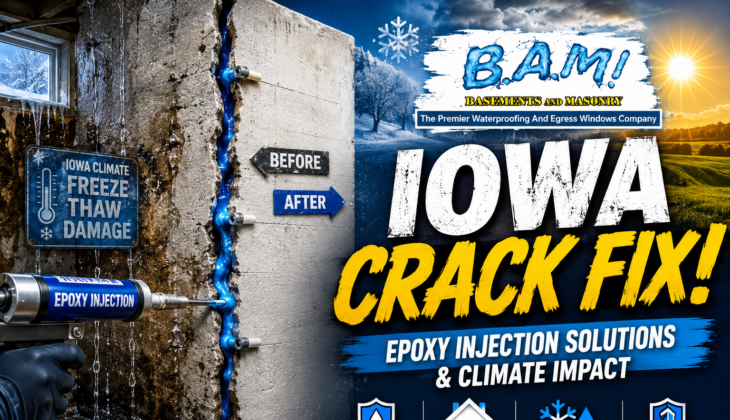
Iowa Foundation Cracks: What You Need to Know First
- Iowa’s clay-rich soils and freeze-thaw cycles create some of the harshest conditions for poured concrete foundations in the Midwest.
- Epoxy injection can structurally weld a cracked foundation back together, but only when the crack is stable, dry, and not actively shifting.
- Choosing the wrong repair method, such as epoxy on an active water leak, can make the problem worse and cost more to fix later.
- Timing your repair around Iowa’s seasons is not optional, it directly affects whether the epoxy bonds correctly or fails entirely.
- Bam Basements works with Iowa homeowners to diagnose the real cause of foundation cracks before recommending a repair approach.
A foundation crack in Iowa is rarely just a crack. It is a symptom of something bigger happening in the soil, the water table, or the structure itself, and the repair method you choose either solves that or ignores it.
Epoxy injection is one of the most powerful tools available for structural foundation repair, but it is also one of the most misapplied. Used correctly, it chemically welds concrete back to near-original strength. Used incorrectly, on a wet crack, a moving wall, or a frozen substrate, it simply does not work. Understanding the difference matters more in Iowa than almost anywhere else, because the climate here puts foundations under constant stress. Bam Basements provides Iowa homeowners with expert diagnosis and repair solutions that go beyond just filling a crack.
Des Moines Iowa Foundation Cracks Are a Climate Problem First
Before any repair conversation begins, it helps to understand why Iowa foundations crack in the first place. The answer is almost always the same: soil movement driven by moisture and temperature change.
Why Clay Soils Make Iowa Foundations Uniquely Vulnerable
Iowa’s soil profile is dominated by expansive clay, which absorbs water and swells when wet, then shrinks and pulls away when it dries out. That constant expansion and contraction puts lateral pressure on foundation walls during wet seasons, then creates voids and settlement gaps during dry periods. Over years, that cycle weakens the bond between soil and foundation and opens cracks that grow wider with each passing season. A foundation sitting in clay-heavy Iowa soil is essentially being squeezed and released repeatedly, year after year.
How Freeze-Thaw Cycles Turn Small Cracks Into Big Problems
Water finds its way into even hairline cracks in a poured concrete wall. In Iowa winters, that water freezes and expands, forcing the crack wider. When it thaws, it pulls back, but the crack does not close back to its original width. Each freeze-thaw cycle ratchets the crack a little further open. A crack that starts as a hairline in October can become a visible structural problem by March. That is not a slow process. Iowa averages dozens of freeze-thaw cycles each winter, and every one of them works against an unrepaired foundation crack.
What Epoxy Injection Actually Does to a Cracked Foundation
Epoxy injection is not a patch or a sealant in the traditional sense. It is a structural repair method that fills the full depth of a crack and bonds the two sides of concrete together at a molecular level, creating a repair that is often stronger than the surrounding concrete when done correctly.
How Epoxy Welds Concrete Back Together
The process works by injecting a two-part epoxy resin under low pressure through a series of surface ports drilled or installed along the crack. The resin flows into the crack from the injection point outward, filling voids, hairline extensions, and the full depth of the wall. As it cures, the epoxy forms a rigid, high-strength bond that effectively fuses the two faces of the crack back together. Structural epoxy used in foundation repair typically achieves compressive strengths exceeding 12,000 PSI, which is well above the strength of standard residential concrete.
Structural Repair vs. Waterproofing: What Epoxy Can and Cannot Do
Repair Goal Epoxy Injection Urethane / Polyurethane Foam Restore structural strength ✓ Yes ✗ No Seal against water intrusion Partial (dry cracks only) ✓ Yes (expands with moisture) Works on actively wet cracks ✗ No ✓ Yes Tolerates crack movement ✗ No (rigid bond) ✓ Yes (flexible) Best for poured concrete walls ✓ Yes ✓ Yes Works in cold substrates ✗ Limited ✓ Better tolerance
Epoxy is the right call when the goal is structural restoration. If the wall has lost integrity from a crack, epoxy brings it back. What epoxy cannot do is flex. Once cured, it is rigid, which means if the crack continues to move after the repair, the epoxy bond can be compromised over time.
Water is the other limitation. Epoxy does not bond well to wet concrete surfaces. If a crack is actively leaking or the concrete is saturated from soil moisture, the epoxy resin cannot make full contact with the substrate, which weakens the bond and can cause the repair to fail. In Iowa, where wet-season soil pressure drives water directly into foundation walls, this is a real and frequent issue.
When Urethane Is the Better Choice Over Epoxy
When a crack is actively leaking, flexible, or part of a wall showing ongoing movement, urethane foam injection is typically the better repair. Urethane expands when it contacts moisture, which allows it to chase water through the crack and seal it from the inside. It cures flexible, so it can tolerate minor movement without cracking. The trade-off is that urethane does not restore structural strength the way epoxy does. Think of it this way: epoxy rebuilds, urethane seals. Both have their place, and the crack itself tells you which one is needed.
Cracks That Are Good Candidates for Epoxy
Not every foundation crack needs the same solution, and epoxy injection performs best in a specific set of conditions. The crack needs to be structurally significant, reasonably stable, and dry enough for the resin to bond properly to the concrete surface on both sides.
Crack Characteristic Good Candidate for Epoxy? Narrow, stable vertical crack in poured concrete ✓ Yes Diagonal crack from corner stress ✓ Yes, if stable Crack with no active water seepage ✓ Yes Crack that has not changed in 6+ months ✓ Yes Hairline crack in a structurally sound wall ✓ Yes, with proper prep Crack in a block or brick foundation ✗ Usually not ideal Crack with visible efflorescence or moisture ✗ Needs further evaluation
Vertical cracks in poured concrete walls are among the most common foundation cracks in Iowa homes and are frequently good candidates for epoxy injection. They typically result from concrete shrinkage during curing or from minor settlement, and as long as they are not actively moving or leaking, epoxy can restore full structural continuity through the wall.
Diagonal cracks that radiate from corners of window openings or door frames can also respond well to epoxy, provided the underlying stress that caused them has been resolved. If soil pressure or differential settlement is still active, filling the crack without addressing the cause is only a temporary fix at best.
Cracks That Are Not Good Candidates for Epoxy
Horizontal cracks are a serious warning sign and are almost never appropriate for epoxy injection alone. A horizontal crack in a poured concrete or block foundation wall typically means lateral soil pressure is actively pushing the wall inward, and that is a structural emergency that requires wall stabilization, not crack filling. Similarly, cracks that are visibly wider at one end than the other, cracks that have displaced one side of the wall relative to the other, and cracks in walls that show bowing or bulging all indicate ongoing movement that epoxy cannot fix. Applying epoxy to an actively moving crack is essentially bonding two things together that are still trying to pull apart. The repair will fail, and the underlying problem will continue to worsen.
Iowa’s Climate Creates Real Limits on Epoxy Performance
Epoxy injection is a chemistry-dependent repair. The resin has to flow into the crack, make full contact with both concrete surfaces, and cure at the right rate to form a strong bond. Iowa’s climate can interfere with every one of those steps.
Temperature, moisture, and seasonal timing are not just logistical concerns when planning a foundation repair in Iowa. They are technical variables that directly affect whether the epoxy performs as intended or fails quietly inside the wall where you cannot see it.
Why Cold Substrates Reduce Epoxy Penetration and Bonding
Epoxy resin is sensitive to temperature. As the substrate temperature drops, the viscosity of the resin increases, meaning it becomes thicker and flows less freely. In a foundation crack, that reduced flow means the resin may not penetrate to the full depth of the wall or reach the narrow hairline extensions branching off the main crack.
Most structural epoxy products used in foundation repair are formulated to cure effectively between 40°F and 90°F. Below 40°F, cure times extend dramatically, and below freezing, many epoxy systems will not cure properly at all. A repair attempted on a frozen or near-frozen substrate may appear to set on the surface while remaining uncured deeper in the wall.
Iowa basement walls in winter can hold temperatures well below what is safe for epoxy injection, especially in unfinished or uninsulated basements where the wall temperature tracks closely with outdoor conditions. Even if the air temperature in the basement feels tolerable, the concrete itself may be too cold for reliable bonding.
The practical implication is straightforward: a winter epoxy injection in Iowa requires either confirmed substrate temperatures within the product’s working range or active warming of the wall surface before and during injection. Skipping that step is one of the most common reasons epoxy foundation repairs fail prematurely in cold climates.
- Below 40°F substrate temperature: Resin viscosity increases, reducing penetration depth and flow into hairline extensions.
- Below 32°F: Most epoxy systems will not cure reliably, and any moisture in the crack becomes ice, blocking adhesion.
- Rapid temperature swings: Can cause the curing epoxy to expand and contract before it fully sets, weakening the bond.
- Uninsulated basement walls: Often hold near-outdoor temperatures even when interior air feels warmer, making wall temperature measurement essential before starting any repair.
Why Ice Inside a Crack Makes Epoxy Fail
Ice is an absolute barrier to epoxy adhesion. If water inside a crack has frozen, even partially, the epoxy resin cannot displace it, cannot make contact with the concrete surface behind it, and cannot cure into a structural bond. What results is a surface-level repair that looks complete but has no real adhesion to the wall. When the ice melts, the gap reopens and the repair separates. Any Iowa foundation repair attempted during or immediately after a freeze event needs to account for the possibility of ice inside the crack, not just on the surface.
How Extreme Heat Can Also Undermine the Repair
Heat is the less obvious threat to epoxy injection, but it is just as real. When substrate temperatures climb above 90°F, the two-part epoxy resin begins to gel faster than intended. That accelerated gel time reduces the window during which the resin can flow and penetrate the crack, which limits how deep the repair actually reaches.
In Iowa summers, a south-facing basement wall or a wall exposed to direct sunlight through a window well can reach surface temperatures well above the safe working range for epoxy, even when the interior air feels comfortable. The cure reaction also generates its own heat, called exothermic heat, and in warm conditions that additional heat can cause the resin to set unevenly or develop internal stress fractures as it cures.
The result is a repair that may look solid on the surface but has compromised internal structure. For summer repairs in Iowa, early morning application when wall temperatures are lower, or working in shaded and climate-controlled conditions, produces significantly more reliable results.
Temperature Condition Effect on Epoxy Injection Iowa Risk Season Below 32°F substrate No cure, ice blocks adhesion December – February 32°F – 40°F substrate Slow cure, poor penetration November, March 40°F – 90°F substrate Optimal cure and penetration April – October (varies) Above 90°F substrate Fast gel, reduced flow depth July – August peaks
The Best Time of Year to Schedule Epoxy Injection in Iowa
The most reliable window for epoxy injection in Iowa is late spring through early fall, roughly April through October, when substrate temperatures consistently fall within the 40°F to 90°F working range. Spring is particularly good because the freeze-thaw cycle has ended, the soil has settled, and basement wall temperatures have recovered from winter lows. It is also easier to assess whether a crack has stabilized or is still moving after the stress of winter.
Fall is a close second, with the caveat that repairs should be completed before the first hard freeze, giving the cured epoxy a full winter to perform under load rather than curing during it. If a repair genuinely cannot wait, such as a crack that is actively worsening in winter, an experienced contractor can use low-temperature epoxy formulations and pre-warm the substrate to extend the working window. But that requires specific products and careful execution, not a standard off-the-shelf injection kit.
The Right Approach to Foundation Repair in Iowa
Getting the repair material right is only half the job. The other half is understanding why the crack is there in the first place and making sure that cause is under control before the injection begins. Iowa foundations rarely crack for just one reason, and the most durable repairs treat the system, not just the symptom.
Fix the Cause Before You Fill the Crack
Filling a crack without addressing what caused it is like patching a roof without fixing the structural damage underneath. The patch holds for a while, then fails again because the underlying force never stopped working. In Iowa, the most common crack causes are hydrostatic pressure from poor drainage, expansive clay soil movement, and settlement from soil that has eroded or compressed under the footing. Each of those requires a different corrective action before epoxy injection will hold long-term.
A proper diagnosis starts with understanding the crack type, its location in the wall, whether it has changed over time, and what the drainage situation looks like around the foundation perimeter. Gutters that discharge too close to the house, grading that slopes toward the foundation, and saturated soil against the wall all maintain the pressure that keeps cracking active. Resolving those conditions before or alongside the epoxy repair is what separates a permanent fix from one that reopens in two seasons.
When to Pair Epoxy With Drainage or Exterior Waterproofing
Epoxy injection handles the crack. It does not handle the water pressure behind the wall that caused it. When a crack has been driven by hydrostatic pressure, which is the force of water-saturated soil pushing against the foundation, sealing the crack from the inside only redirects that pressure to the next weak point. In those cases, epoxy needs to be paired with a drainage solution that relieves the pressure at the source.
Interior drain tile systems, sump pump installation, and exterior waterproofing membranes are the most common pairings with epoxy injection in Iowa. Exterior waterproofing is the most comprehensive option because it addresses moisture before it ever contacts the foundation wall, but it is also the most invasive and expensive. Interior drain tile manages water after it enters the wall cavity, keeping it from pooling against the footing. The right combination depends on how severe the water intrusion is, how old the foundation is, and whether the crack is isolated or part of a larger moisture pattern throughout the basement.
Signs the Foundation Needs Stabilization, Not Just Epoxy
Some foundations have moved beyond what epoxy injection can address. If a basement wall is visibly bowing inward, if horizontal cracks run across the mid-section of the wall, if cracks are wider at one end than the other, or if doors and windows in the home are sticking or jamming, the foundation is likely still moving. In those situations, the priority is stopping the movement first, using methods like carbon fiber straps, wall anchors, or helical piers, before any crack repair is attempted. Epoxy applied to an unstabilized wall is a temporary measure at best. A professional evaluation that includes measuring wall deflection and assessing soil pressure conditions is the only way to know for certain whether stabilization is needed before injection.
Iowa Foundation Repair Done Right: Epoxy Works When the Conditions Do
Epoxy injection is one of the most effective structural repair tools available for poured concrete foundations, but it is not a universal solution. It works when the crack is stable, the substrate is dry enough, the temperature is within range, and the underlying cause of the damage has been identified and controlled. When those conditions are met, an epoxy repair can restore a cracked foundation wall to near-original structural strength and last for decades without requiring retreatment.
Iowa makes those conditions harder to achieve than most places. Clay soils, aggressive freeze-thaw cycles, high seasonal moisture, and temperature swings that push against both ends of epoxy’s working range all raise the bar for a successful repair. That is not a reason to avoid epoxy injection. It is a reason to approach it with the right diagnosis, the right timing, and the right professional doing the work.
The homeowners who get the best results are the ones who treat the crack as a signal rather than just a defect. They find out why the crack is there, fix what caused it, time the repair correctly, and choose the right material for the specific crack in front of them. Done that way, epoxy injection is not just a patch. It is a permanent structural restoration that stops the problem at its source.
Frequently Asked Questions
Foundation repair questions are common, and the answers are not always straightforward because the right solution depends on the specific crack, wall, soil, and season involved. The questions below reflect what Iowa homeowners ask most often when they are trying to decide how to handle a foundation crack.
Use these answers as a starting framework, but understand that no two foundation cracks are identical. A qualified foundation specialist should always evaluate the crack in person before any repair method is selected.
Can epoxy injection be done in winter in Iowa?
It can be done in winter, but it requires careful preparation and should not be attempted as a standard DIY repair during cold months. The concrete substrate needs to be above 40°F for most epoxy systems to cure properly, and the crack must be completely free of ice or frozen moisture before injection begins.
In Iowa winters, uninsulated basement walls often drop well below that threshold, even when the air inside the basement feels tolerable. A contractor experienced with cold-weather epoxy repair will measure substrate temperature directly, use low-temperature epoxy formulations rated for cold conditions, and warm the wall surface before injection if needed. Without those steps, a winter repair may look complete on the surface while failing to bond at depth inside the wall.
Winter Condition Repair Feasibility Required Precaution Basement substrate above 40°F ✓ Feasible Verify with contact thermometer Substrate between 32°F and 40°F △ Marginal Use low-temp epoxy, pre-warm wall Substrate below 32°F ✗ Not recommended Postpone or heat space aggressively Ice visible inside crack ✗ Do not proceed Allow full thaw before repair
If the repair is urgent and cannot wait until spring, the most reliable path is to have the basement interior temperature maintained above 50°F for at least 24 hours before the repair and throughout the curing period, which typically runs 24 to 72 hours depending on the epoxy system used.
For non-urgent repairs, scheduling in April or May after the final freeze-thaw cycle has passed gives epoxy the best possible conditions for full depth penetration and a durable cure. Patience in timing is one of the most underrated parts of a successful foundation repair in Iowa.
How long does epoxy injection last on a foundation crack?
A properly executed epoxy injection repair on a stable crack in a poured concrete wall can last the lifetime of the foundation. Because cured structural epoxy typically exceeds the compressive strength of the surrounding concrete, the repaired area is not the weak point anymore. The caveat is that longevity depends heavily on whether the underlying cause was resolved. If soil pressure, poor drainage, or ongoing settlement continues to stress the same area of the wall, new cracks can form adjacent to the repair even if the original epoxy bond holds.
Will epoxy stop water from coming through my foundation wall?
Epoxy injection seals a crack against water intrusion as part of the structural repair, but only when the crack is dry at the time of injection. If the crack is actively leaking or the concrete is saturated, epoxy will not bond properly and the water seal will be incomplete. In that case, urethane foam injection is the more appropriate first step because it is designed to expand on contact with moisture and seal actively wet cracks.
It is also worth noting that sealing a crack does not eliminate the water pressure behind the wall. If hydrostatic pressure is significant, water will eventually find another path through the foundation unless the drainage situation around the home is addressed. Epoxy handles the crack. Managing the water that caused it requires a broader drainage solution.
What is the difference between epoxy and urethane foam injection?
Epoxy injection is a structural repair that bonds the two sides of a crack together and restores compressive strength to the wall. It is rigid when cured, requires a dry substrate, and is best suited to stable cracks in poured concrete where structural integrity is the primary concern. Urethane foam injection is a waterproofing repair that expands when it contacts moisture, filling the crack and creating a flexible seal that can tolerate minor movement. It does not restore structural strength but performs well on actively wet or slightly moving cracks. The choice between them is driven by what the crack is doing, not personal preference. Structural problem, use epoxy. Active water intrusion or movement, use urethane.
Do I need a professional for epoxy injection or can I DIY it?
DIY epoxy injection kits are widely available, and for a narrow, stable, dry hairline crack in an otherwise sound poured concrete wall, a careful homeowner can achieve a reasonable result. However, the margin for error is significant, and the consequences of a failed repair include both wasted cost and a crack that is now partially filled with failed material, which can complicate a professional repair later.
The most common DIY mistakes include injecting into a substrate that is too cold or too wet, spacing ports incorrectly so the resin does not travel the full depth of the crack, using an epoxy product not rated for structural foundation repair, and failing to identify whether the crack is still active before attempting the repair. Any one of those errors can result in a repair that looks finished but has not actually bonded to the wall.
Professional foundation contractors use calibrated low-pressure injection equipment, substrate thermometers, moisture meters, and structural-grade two-part epoxy systems with verified compressive strengths. They also carry the diagnostic experience to identify whether epoxy is even the right material for the crack in front of them, which is the most important step of all.
If you have any doubt about the cause of the crack, whether it is still moving, or whether the conditions are right for epoxy, that is the moment to call a professional. A consultation costs far less than repairing a failed DIY attempt on a foundation that needed a different solution from the start.
Bam Basements helps Iowa homeowners get foundation repair right the first time, from diagnosis through repair, with the right method for the specific crack and conditions involved.